
As a renowned IT professional for over 4 decades, naturally I take the concept of vibe coding as a personal insult to my profession - how dare people rock up and have a full working system in a matter of days.
So when I see pictures such as this:
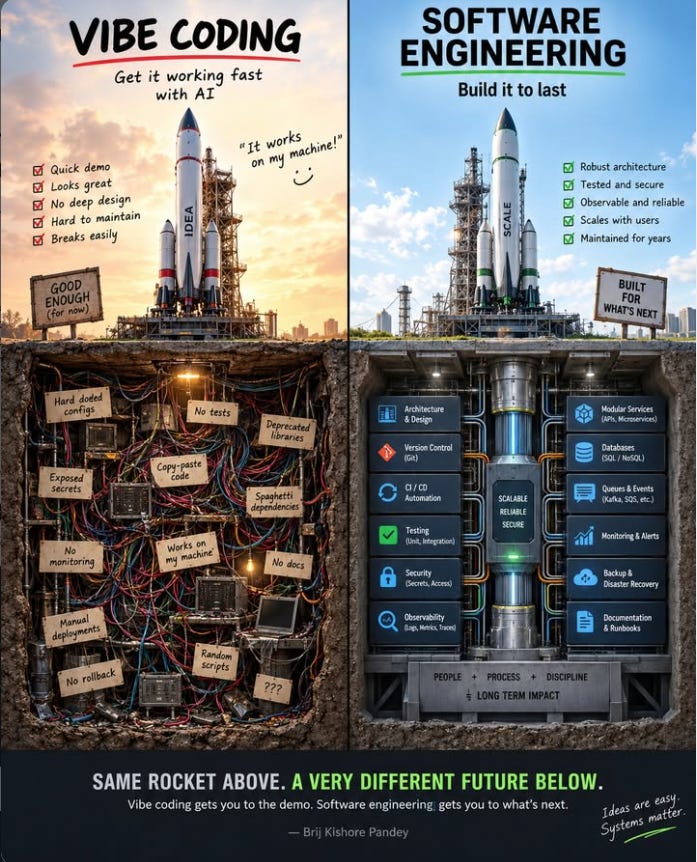
I smile inside, or outwardly laugh, how could anyone take the left hand rocket, with so many failing, seriously.
Not dissimilar to the agile / waterfall conflict a few years ago, however that’s for another time.
However, lets put the crusade to one side and have a really good, unbiased look at the failings of the vibe coded rocket.
Many years ago, I took a job at a small established software company, with a good product, health turnover and sufficient staff with enough skill to support and develop the product.
So why did every negative of the vibe coded rocket apply to this successful and outwardly professional software company?
I have a number of theories:
The Growing a Start-up Theory
You have a business idea for a software product and you need to make sure people will pay enough money to support your lifestyle, so you build a Minimum Viable Product or MVP.
The problem is that unless you have deep pockets and/or loads of time on your hands and are happy to architect the full system before showing anyone, ideally you need to Frederick, which means favouring the prototyping route, surely the forerunner of vibe coding. The result is likely to be a cantankerous beast of a product, that requires hand cranking, scripts and intimate knowledge of what is going in and out of a system to get it to work. Or it’s a series of screens or web pages that are joined together and do very little.
Assuming the the MVP is successful and you proceed, you have two options. Throw away the prototype, then specify, plan and build a higher quality rocket, or turn the prototype into the full product.
Steve McConnell in Code Complete treats throwaway prototyping as a deliberate strategy. In his framing, the prototype is thrown away by plan, and the danger is the prototype quietly becoming the product. That is close to Frederick P. Brooks Jr’s position in The Mythical Man-Month: Essays on Software Engineering in the 1975 edition, however in 1995 Brooks had changed his mind, which was clearly stated in the new chapters. Revisiting The Mythical Man Month after 20 years is interesting, you can see the friction between the waterfall method and what became the agile methodology. As \i said earlier, a topic for another time.
It’s hard to throw working code away, particularly in a start-up hungry for income, regardless of the shortcuts taken, which is why you end up with the rocket on the left even if you have no idea what vibe coding is.
Sorting out the shortcuts takes time, persistence and an ability to prioritise those that could lead to a blank screen on a Monday morning. I’m looking at these on a day-to-day basis, and planning and executing a sequence of re-development that offers resilience and security.
The Low Staff Turnover Theory
Some companies I’ve worked for have has a phenomenally low staff turn over. This is a fantastic achievement by the owners of the company, however there is a flaw in this; fewer new ideas and techniques.
New staff have experience with alternate technologies and approaches that can improve a software product, whether that’s visible to the user base or invisibility improves the resilience, security or simply means fewer nights and weekends applying updates to the product.
I have experienced cases where suggested changes are rejected out of hand and others where the idea is quietly side-lined. Maybe they weren’t good ideas.
I’ve also experienced changes that were fully embraced and made a substantial difference to the process of developing and supporting the product.
The Rock Star Theory
This can overlap with the Low Staff Turnover Theory and involves an individual with a rock star persona, sometimes the business owner, sometimes a long standing member of staff, who believes their way is the only way.
I suggested SignalR to the architect working on the conversion of a desktop package to a web application. “No. End off” was his curt reply. I was somewhat surprised to find SignalR being used some months later. The same individual struggled with version control, overwriting months of work (thankfully recoverable) because his changes were the only ones that matter.
I’m not suggesting that every idea raised need to be considered, however rejecting industry standard ideas, such as unit testing, out of hand, needs addressing. Or you end up with a very messy rocket.
What’s the Solution
Considering every idea and new technique isn’t the solution, your product will never move forwards. If you have an ideas factory with output so high it’s stopping all other work, or at least a large proportion, it’s time to slow it down and possibly shut it down.
If a prototype of vibe coded project has made it into the hands of paying customers, at some point you have to look at the corners cut and address them. Lists and priorities are good here, understanding what needs to be done and in what order means you can deal with the potentially business shattering elements first; products running on unsupported infrastructure, for example, out of support operating systems or unpatched versions of frameworks, log files containing important error information that go nowhere, and passwords in version control.
Plan these changes alongside feature requests, so the user sees some change and benefits from improvements that remain invisible.